

Pricing custom pieces: a cost-of-goods + skilled-time markup model
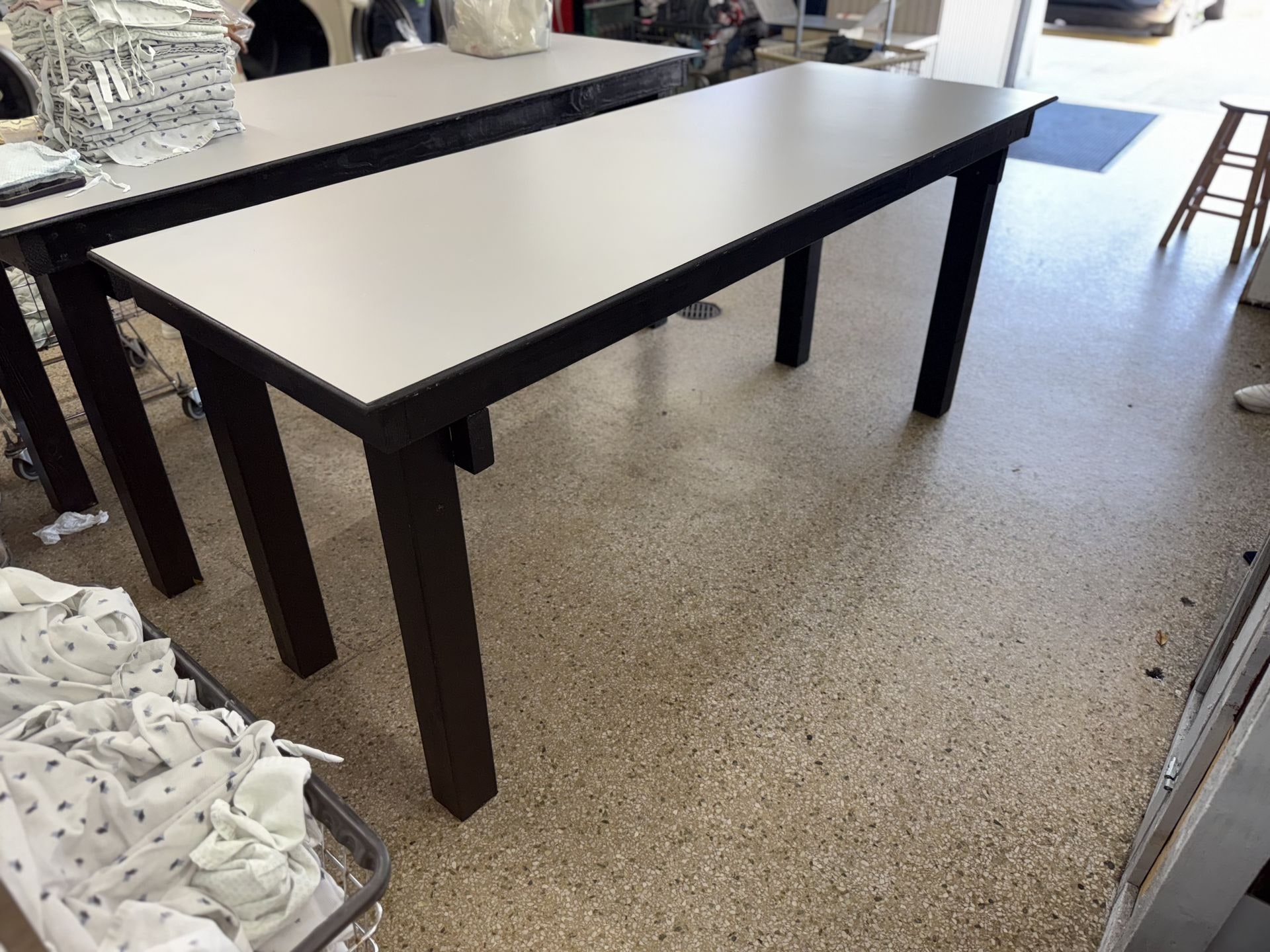
Quoting custom furniture is the part of the job that breaks most small shops. Either the price is too low and the build eats money, or it is too high and the client walks. We use a four-component model that has held up for nine years and produces a quote that is defensible line by line.
The four components of a real quote
1. Cost of goods (COG). Raw materials, finish, hardware, fasteners, shop consumables.
2. Shop overhead. Rent, power, insurance, tooling amortization — allocated per project.
3. Skilled labor time. Honest hours at a real shop rate.
4. Profit margin. What keeps the business solvent and capitalizes the next investment.
The total quote is the sum of those four. Each one gets calculated separately so the client can see what they are buying and the shop can spot where a quote is bleeding.
Cost of goods — the easy one, with a hidden multiplier
Materials and hardware add up cleanly. A 24-inch dining table in white oak runs roughly:
- 32 board feet of white oak @ $11/bf = $352
- Steel base hardware (knock-down threaded inserts, leveler feet) = $85
- Finish — 3 quarts wipe-on poly + brushes + lint-free rags = $110
- Glue, screws, fasteners, sandpaper progression = $60
- Subtotal COG: $607
The hidden multiplier: waste and pre-build error. A board foot ordered is not a board foot used. Knots, splits, sapwood, planer snipe, layout errors all eat material. The shop rule is multiply COG by 1.20 to cover normal waste. That brings the line to $728.
If the piece is a one-off design or uses species the shop has not handled before, multiply by 1.30 instead — first-time builds always burn more material.
Shop overhead — the one most hobbyists miss
A working shop has fixed monthly costs. For a typical 2,000-square-foot Florida shop with three primary stations:
| Line item | Monthly |
|---|---|
| Rent + utilities | $2,400 |
| Insurance (general liability + tools) | $450 |
| Tool depreciation (5-year straight-line on $40k of stationary tools) | $670 |
| Software, marketing, accounting | $300 |
| Shop supplies (blades, abrasives, lubricants) | $250 |
| Total monthly overhead | $4,070 |
If the shop produces 8 billable projects per month, allocated overhead is $509 per project. If the shop runs at 5 projects per month (off-season), it climbs to $814 per project. We average across the year and use $575 per project as the standing overhead allocation.
Note: this is just per-project allocation. Larger projects (kitchen built-ins, full dining sets) take a multiplier — a 200-hour project is allocated more overhead than a 30-hour one. We use $5/hour of shop-floor time as the rolling overhead factor for big jobs.
Skilled-time rate — the line that scares everyone
This is where most small shops underprice themselves out of business. The honest math:
- A working woodworker with 5+ years of shop time wants to earn $65,000–$95,000/year to make a career of this. Call the midpoint $80,000.
- Loaded payroll cost (FICA, workers' comp, health benefits) adds ~35% — so the actual cost to the shop is ~$108,000/year per skilled woodworker.
- Annual billable hours, accounting for vacation, training, sick time, and shop maintenance, is roughly 1,600 hours per year (not 2,080).
- Per-billable-hour cost: $108,000 / 1,600 = $67.50/hour.
That is the shop's cost — not the shop's rate. The rate must cover the cost and contribute to profit. Our shop rate has been $95/hour of skilled time since 2024. Below $80/hour, the shop loses money on every billable hour. Above $110/hour, we start losing clients to other custom builders.
For the 24-inch dining table example: estimated build time is 22 hours of skilled work (milling, joinery, glue-up, sanding, finishing). At $95/hour that is $2,090.
Profit margin — what keeps the lights on
After COG (with waste multiplier), overhead, and labor, the project has a "true cost." Our standing markup is 18% profit margin on top of that subtotal.
For the dining table:
- COG (with waste): $728
- Overhead (per-project): $575
- Skilled labor (22 hrs × $95): $2,090
- Subtotal: $3,393
- Profit margin (18%): $611
- Final quote: $4,004
Round to $4,000.
What this protects against, and what we don't do
The breakdown makes the quote defensible — when a client asks "why $4,000?" we hand over the four lines. Forty percent material, 50% labor, 10% overhead, 18% profit. It also protects against scope creep: "add a leaf insert" answers as "6 hours of labor and ~$80 of material," re-quoted in 60 seconds.
We will not quote per-square-foot or per-linear-foot on custom work. Those benchmarks fit repetitive production (decks, fencing, cabinetry runs). Custom labor swings 3x by joinery complexity. Per-foot pricing forces over-quoting simple work or under-quoting complex work.
> If you are commissioning custom furniture and the quote is a single number with no breakdown, ask for the four lines. A builder who cannot produce them is either disorganized or hiding the math.
References: National Federation of Independent Business, "Small Manufacturing Margins Survey 2024." Custom Woodworking Business Magazine, "Shop Rate Calculations for Custom Builders" (Vol. 38, Issue 3, 2023). US Bureau of Labor Statistics OES data for "Cabinetmakers and Bench Carpenters," Occupation Code 51-7011.
- #pricing
- #business
- #cost-of-goods
- #shop-rate
- #custom-furniture