

Wood movement: engineering for seasonal humidity changes
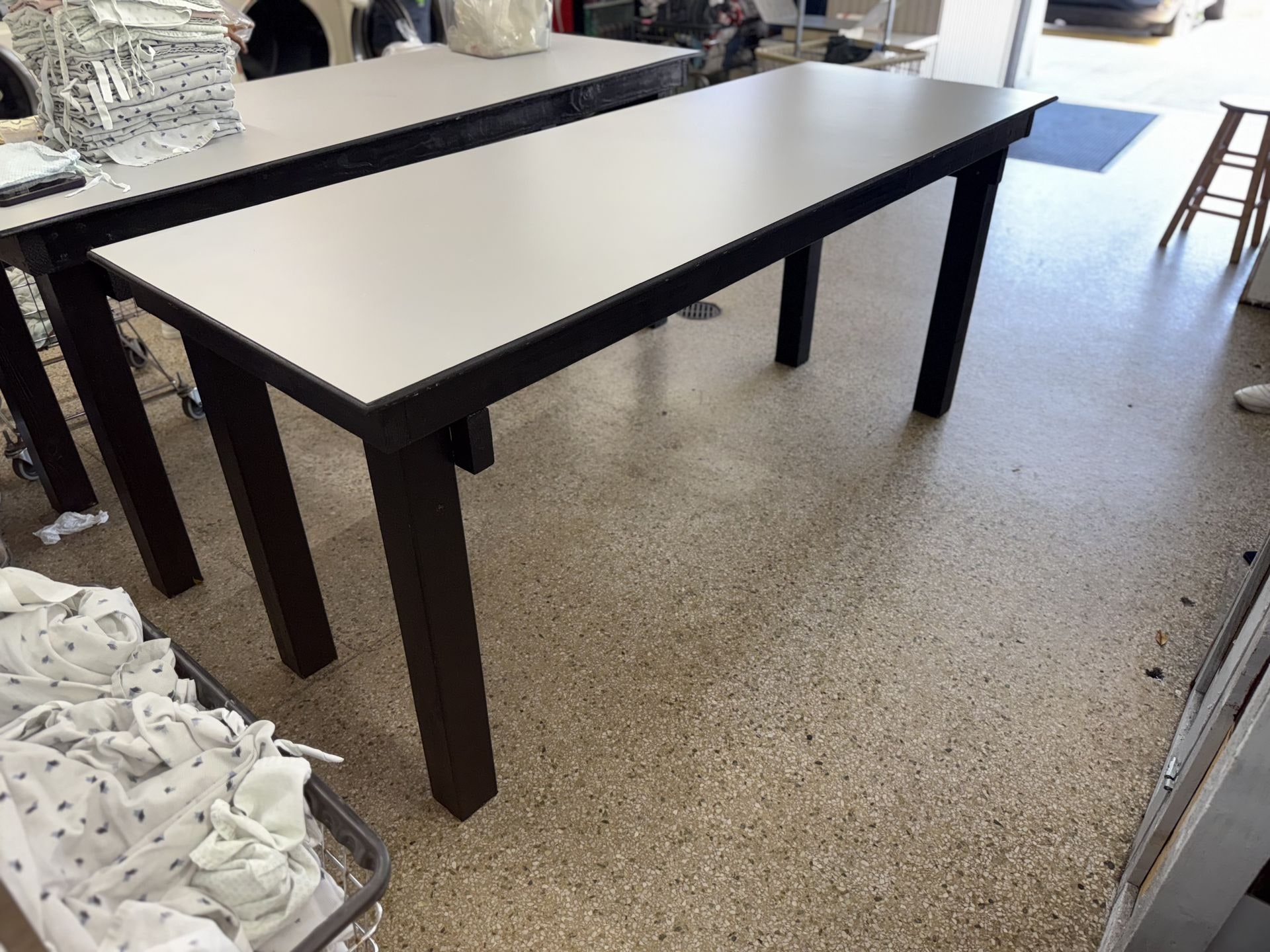
Every piece of solid-wood furniture is a moving part. Pretending otherwise is how kitchen tables crack down the middle in February and how dresser drawers stop opening in August. Here is the working math we use on the shop floor.
Wood breathes — and the numbers are knowable
Lumber reaches equilibrium moisture content (EMC) with whatever air surrounds it. In a typical climate-controlled Orlando home, indoor EMC swings from about 6% in January (heat on, dry) to 11–12% in August (humid). That ~5–6 point swing is what every piece you build has to absorb.
Wood does not move uniformly. The USDA Forest Products Laboratory Wood Handbook (Ch. 4, "Moisture Relations and Physical Properties") publishes shrinkage coefficients for every common species. The headline numbers:
- Tangential shrinkage (across the face of a flat-sawn board, the direction that moves the most): roughly 7–11% from green to oven-dry.
- Radial shrinkage (across the face of a quarter-sawn board): about 4–6%.
- Longitudinal shrinkage (along the grain): negligible, usually 0.1–0.3%.
The practical rule: a 12-inch-wide flat-sawn white oak tabletop will gain or lose roughly 1/4 inch across the grain between January and August in a typical Florida home. That is not a typo. A 36-inch glued-up top moves three-quarters of an inch over the year.
Where furniture fails
Three failures cover 90% of what walks back in the shop door:
- Tops attached rigidly to aprons. The top wants to move; the apron is fixed; something has to give. Usually the top cracks down a glue line. Fix: figure-8 fasteners, wood buttons, or slotted metal Z-clips so the top can slide.
- Breadboard ends pinned across the full width. A breadboard end runs cross-grain to the top. If you pin it in three or more places with no slots, the top will split between the pins. Fix: glue and pin only the center; elongate the outer pin slots by 1/4 inch each side.
- Drawers built tight to the case in winter. Sized to slide perfectly in February, they swell shut by July. Fix: leave 1/16 inch on each side of the drawer front and 3/32 inch on top for a 24-inch-wide drawer. Build the drawer in summer if possible — you can always pad winter, you cannot un-trim swelling.
How we calculate the movement
For any tabletop, drawer front, or panel, the working formula is:
> Movement (inches) = Width × (Δ EMC %) × Shrinkage Coefficient × 0.01
For a 24-inch-wide flat-sawn cherry top, with a 5% EMC swing and a tangential shrinkage coefficient of 7.1%:
> 24 × 5 × 7.1 × 0.01 = 0.85 inches per 24 inches — call it 7/8 of an inch annual movement.
Quarter-sawn material moves about half that. This is the whole reason a lot of high-end shops insist on rift- and quarter-sawn for tabletops: not because it looks better (debatable), but because it moves predictably and less.
Practical accommodations we build in
Every solid-wood piece leaves our shop with at least one of these designed in:
- Slotted fastener holes on all aprons, stretchers, and case backs that hold a top.
- Floating panels in raised-panel doors — never glued in the grooves, sized 1/8 inch undersized in the cross-grain direction.
- Frame-and-panel case sides instead of solid slabs anywhere a panel exceeds 14 inches wide.
- Acclimation — every board sits in the customer's home (or, more often, our shop with similar conditions) for at least two weeks before final dimensioning. Moisture-meter readings logged before we start cutting.
The one shortcut that does not work
People ask if a thick film finish "seals" the wood. It does not. A spar urethane slows moisture exchange — it does not stop it. The wood reaches EMC anyway, just on a longer time constant. Build the movement in. The finish is for looks and abrasion resistance, not for fighting physics.
> If you are commissioning a solid-wood piece for a Florida home, ask the builder how they accommodate wood movement. If the answer is "we use thick finish," walk away.
References: USDA Forest Products Laboratory, Wood Handbook (FPL-GTR-282, 2021), Chapter 4. Hoadley, R. Bruce. "Understanding Wood: A Craftsman's Guide to Wood Technology" (Taunton Press, revised 2000), Ch. 5–6.
- #wood-movement
- #humidity
- #seasonal-change
- #engineering
- #tabletops
- #joinery